Humanoid Robotics: The Ultimate 10-Step Guide to Our Mechanical Counterparts

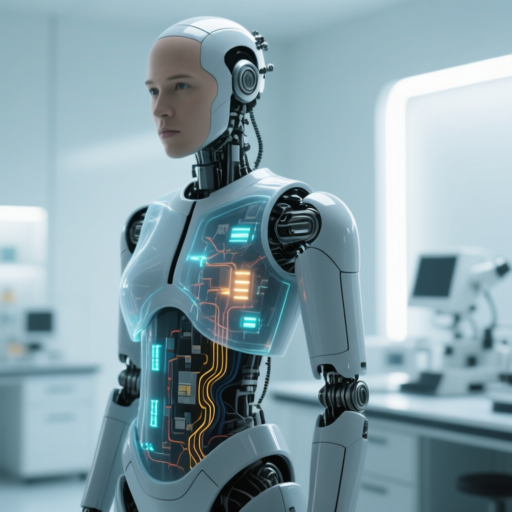
Table of Contents
Introduction: More Than Just a Machine
The Uncanny Valley: The Psychology of the Humanoid Form
A Brief History: From Ancient Myths to Modern Motors
The Anatomy of a Humanoid: Deconstructing the Bipedal Bot
4.1 The Brain: AI and Neural Networks
4.2 The Body: Actuators, Sensors, and the Skeleton
4.3 The Senses: Vision, Touch, and Balance
The 10-Step Breakdown: How a Humanoid Robot is Conceived and Built
Real-World Applications: Where Humanoids Are Making a Difference
6.1 Manufacturing and Logistics
6.2 Healthcare and Elderly Assistance
6.3 Search, Rescue, and Hazardous Environments
6.4 Research and Space Exploration
The Titans of the Industry: Case Studies of Leading Humanoids
7.1 Boston Dynamics’ Atlas: The Acrobat
7.2 Honda’s ASIMO: The Pioneer
7.3 Tesla’s Optimus: The Aspiring Mass-Produced Bot
7.4 Ameca: The Face of Humanoid Expression
The Ethical Conundrum: Job Displacement, Safety, and Consciousness
The Future Trajectory: Where Do We Go From Here?
Conclusion: A Partnership in Progress
1. Introduction: More Than Just a Machine
For centuries, the idea of creating an artificial being in our own image has captivated the human imagination.
What was once a hallmark of science fiction is now a focus of many of the contemporary world’s top engineers and AI researchers: the modern humanoid robot. It is now one of the most ambitious and intricate branches of technology. But why is there such a fascination with creating an advanced robotic version of ourselves? This guide will provide an overview of the world of humanoid robotics: its history, mechanics, uses, and complex moral conundrums. As we work on crafting intricate and elegant tools of robotics and AI, we are also building the world’s first advanced system designed to function independently in a human-centric world.
2. The Uncanny Valley: The Psychology of the Humanoid Form
Why might a vacuum cleaner not bother us because of its robotic design, yet androids could make us very uncomfortable? The Uncanny Valley might have the answer. It states that emotional responses toward robots are generally positive. Still, the more humanlike they get, the more the emotional response is heavily weighted toward negativity, up to and including disgust. A very humanlike robot may evoke empathy as a response, except when the resemblance is only slightly off. That distorted form of empathy is a response designers of humanoid robots should consider. If they design for more compassion and acceptance, should they create for an obvious difference in robotic versus human? Or smooth out the difference to humanlike realism? The answer to the question will greatly influence how much empathy potential customers attach to machines.
3. A Brief History: From Ancient Myths to Modern Motors
This vision of a humanoid robot is not new. The Greeks spoke of Talos, a giant bronze automaton, and medieval times saw the clockwork cleverness of many artisans. The beginning of modern humanoid robotics, however, is firmly placed in the mid-20th century.
William Grey Walter created tortoise-like machines named Machina Speculatrix that modeled complex behaviors and behaviors that were early forms of robotics in 40’s and 50’s.
In 70’s Waseda University in Japan was the first to develop and walk and communicate with people in a process they called the WABOT project, with their creation of WABOT-1-1 1 the first intelligent humanoid robot that was also able to grasp objects with its hands.
In the 90s, Honda was also very secretive about its projects. Still, eventually the world was introduced to ASIMO, a robot that was able to walk smoothly and dynamically, which captured the attention of the world.
Since the 2000s, Boston Dynamics has been completely focused on the agility of robotics, a complete shift in the paradigms of robotics. Robotics had not previously focused on the agility that PETMAN and Atlas created with robotics that had the ability to perform dynamic and acrobatic movements. Boston Dynamics was focused on the agility of robotics in a manner that was both acrobatic and dynamic. At this time, the world was also starting to experience the advent of AI.
4. The Anatomy of a Humanoid: Deconstructing the Bipedal Bot
Engineering on a quest to replicate the effortless human movement in any humanoid robotics is indeed an engineering nightmare. Yet this is a result of fine engineering in about a dozen different kinds of engineering in each robot.
4.1 The Brain: AI and Neural Networks
The AI we give to a humanoid to mimic the brain of a human consists of some very advanced technologies and behaviors of robotics behaviors, and this AI includes the following:
Computer Vision: This allows a robot to detect objects of people, and to a good extent able to maneuver through a space without obstacles.
Natural Language Processing (NLP): This allows AI to interpret and answer in a vocal manner to commands that are spoken.Machine Learning Models: The ability for a system to improve its capabilities with every task it completes.
Motion Planning Algorithms: The complicated software that determines the movement of every joint to complete a task, such as walking up a flight of stairs or grasping a cup.
4.2 The Body: Actuators, Sensors, and Skeleton
The humanoid’s body has a physical representation of the body’s interface with the environment. The main components are:
Actuators: The “muscles” of the robot, usually electrical motors or hydraulic systems that move.
Skeleton: A strong and lightweight structure usually made of aluminum, titanium, or carbon composite.
Power Supply: A significant obstacle to overcome for most humanoid robots. Most of them rely on heavy batteries, which limit the operational time.
4.3 The Senses: Vision, Touch, and Balance
A humanoid has to be able to understand its surroundings. This is done with a set of sensors.
Cameras (Eyes): Stereo and depth-sensing cameras like the Intel RealSense.
LiDAR (Light Detection and Ranging): Provides a 3-dimensional representation of the environment.
Force-Torque Sensors (Touch): Located in the wrists and ankles, they measure the forces that touch the robot to allow for the manipulation of small and delicate objects.
IMUs (Inertial Measurement Units – Balance): Think of IMUs as the robot’s inner ear. It prevents the robot from falling and measures the orientation and angular velocity of the robot.
5. The 10-Step Breakdown: How a Humanoid Robot is Conceived and Built
Designing a single humanoid is a considerable challenge. Here is a simplified 10-step summary of the huge process:
Define the Purpose: It is vital to define the purpose of the humanoid as research, manufacturing, or customer service, as the aim will influence the design.
Conceptual Design: The engineers and the designers produce primary drafts as well as 3D models along with a decision on the robot’s size, weight, and degrees of freedom (how a joint can move).
Software Simulation: Before any metal is cut, everything in the robot, also its movements, is simulated using a virtual environment. It’s at this stage that the gait cycles and other complex tasks are refined.
Mechanical Design and Fabrication: Every component gets detailed models created using CAD, and each component gets manufactured, 3D printed, or cast.
Actuator and Drive-Train integration: The units involved in power and test assembly are the motors and mechanisms that power the robot’s joints.
Sensor Integration: All cameras, LiDAR, IMUs, and touch sensors are wired into the system.
Low-Level Control System Development: This is the firmware that communicates with the hardware, ensuring that a move arm command is executed with a millisecond or two of lag.
How Vision, Planning, and Learning Algorithms Create a Mind
People see, plan, and learn using their brains. We attempt to replicate this using “vision”, “planning,” and learning at the algorithm level.
What the system can do
At this point, all the components are integrated. With multiple iterations, the system is placed in a loop of constant testing, from bench testing the system to full system testing.
Finalization
The data from the system informs the software and the system design. This process is designed to create a high level of integration and optimization.
6. Real-World Applications: Where Humanoids Are Making a Difference
The most advanced humanoids are just starting to leave the lab and are being used in specialized fields.
6.1 Manufacturing and Logistics
In car manufacturing companies such as BMW, humanoids are used to perform repetitive tasks that are ergonomically challenging.
6.2 Health and Elderly Assistance
As the populations age globally, humanoids are being used as companions and assistance for older people. They can remind people of things, fetch them, and even monitor their vitals, allowing them to live alone independently and for longer periods of time.
6.3 Search, Rescue, and Hazardous Environments
Bipedal Search-and-Rescue Robots would be a lifesaver. After an earthquake or a nuclear disaster, these humanoids would be able to traverse rubble, climb ladders, and turn valves in environments designed for humans. It would be impossible for tracked or wheeled robots to complete these types of tasks.
6.4 Research and Space Exploration
Valkyrie is a humanoid designed for space and is a part of one of NASA’s missions. The target is for this humanoid to complete extra-vehicular activities or prepare Mars habitats for humans.
7. The Titans of the Industry: Case Studies of Leading Humanoids
7.1 Boston Dynamics’ Atlas: The Acrobat
Probably the most dynamic humanoid on the planet. It’s known for parkour videos because of an unprecedented level of agility, balance, and coordination. It’s a research platform, but most humanoid machines are less advanced, so it is definitely a leader in the field.
7.2 Honda’s Asimo: The Pioneer
Asimo is now retired, but for two decades, it was the ambassador for humanoid robotics. It showed the world that smooth and stable bipedal locomotion was achievable and demonstrated running, hopping, and walking up and down stairs.
7.3 Tesla’s Optimus: The Aspiring Mass-Produced Bot
What makes Tesla’s Optimus (or Tesla Bot) differentiation compared to others in the industry is the focus on making this a mass-produced and affordable humanoid robot. Other humanoid robots in the industry focus on having the ability to walk. Optimus is able to perform functions in a Tesla workplace. Tesla plans to utilize their advancements in AI and batteries to make a general-purpose humanoid to accomplish what it describes as “unsafe, repetitive, or boring tasks”.
7.4 Ameca: The Face of Humanoid Expression
Ameca is focused on being the most lifelike and expressive humanoid for the industry. Ameca is not focused on being the most advanced in walking (which is an ability some of the other humanoids are focused on), and is the most advanced in being able to control its face and perform different expressions in a convincing manner. Ameca is designed to study and improve the interactions and communications between a human and a robot.
8. The Ethical Dilemmas **Job Displacement, Safety, and Sentience
These advanced, highly humanoid robots introduce modern-day ethical dilemmas. What does the future of the human workforce look like? There is a need for discussion of Universal Basic Income and some form of workforce retraining for the affected.
Ensuring Safety & Control: How do we ensure that very powerful humanoids with ultra-complex AI will not inflict lethal damage on human beings? The Three Laws of Robotics are a fable, and we must think of real-life safety frameworks with ‘kill switches’ and human-override controls.
AI Safety, Rights and Consciousness: And, if a humanoid ever achieves a form of sentience or consciousness, what would such a being be entitled to? What rights would it have? This concern, albeit a far-off prospect, is a philosophical debate that we are already beginning to automate.
9. The Future Trajectory: Where do we go from here?
The next decade of humanoid robotics is to be governed by technological AI, Differentiation from smart robots.
Artificial Intelligence Integration: The onboarding of more sophisticated, general-purpose AI that enables a humanoid to comprehend and act on multifaceted commands will be a breakthrough.
Battery and Power density: Significant breakthroughs in energy density will be fundamental in constructing humanoid robots that will sustain power for 8-10 hours of functional work without needing to recharge.
Planet-Reducing Assistance: The path to universal adoption largely centers on pressing, planet-destroying technological innovation. This will lead to affordable access for business, and more so, general of the general populace.
Human-robot collaboration: The next-gen humanoid will be a collaborative partner: a ‘cobot’ designed to complement human capabilities. The future will not be robots replacing us, but rather working in conjunction with, to enhance productivity.
10. Conclusion: A Partnership in Progress
Every new prototype in the development of a true, fully self-sufficient, and autonomous humanoid is a step in the right direction. When a new humanoid prototype takes its first, uncertain steps or correctly opens a door, we march proudly into the future, bringing with us the most advanced engineering and computing technology of the day. These creations are reflections of ourselves. They push the boundaries of how we define what it means to be human: to move, learn, and interact. They are not meant to act as human enslaved people or replacements, but rather as partners in progress. Developed with the right technology, the autonomous humanoid could be the most impactful and transformative technology of our time.
you may also read weightedgpacalculator.
